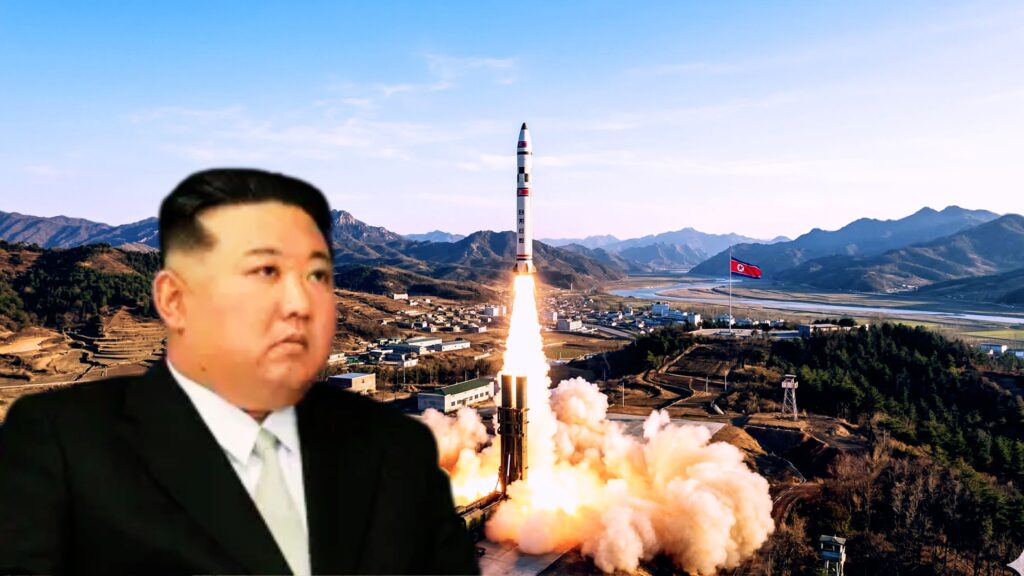
The latest North Korea missile launch has sparked international concern after Pyongyang fired around 10 suspected ballistic missiles toward the Sea of Japan, escalating tensions in Northeast Asia.
Officials from South Korea’s Joint Chiefs of Staff confirmed that the launches took place from the Sunan region near Pyongyang, sending multiple projectiles toward the sea off North Korea’s east coast. The missiles reportedly traveled hundreds of kilometers before landing in waters east of the Korean Peninsula.
The launches came amid ongoing US-South Korea joint military exercises, which North Korea frequently condemns as rehearsals for invasion. The incident has intensified regional security concerns and prompted emergency monitoring by both Japan and South Korea.
Ballistic Missile Launch Detected by Japan and South Korea
The North Korea missile launch triggered immediate responses from both Seoul and Tokyo.
According to South Korea’s Joint Chiefs of Staff, several suspected ballistic missiles were launched almost simultaneously. These missiles flew roughly 340–350 kilometers before falling into the sea east of the Korean Peninsula.
Japan’s coast guard also detected the launches and issued alerts to maritime traffic in the region.
Officials from Japan’s Defense Ministry later confirmed that the projectiles did not land inside Japan’s exclusive economic zone (EEZ), and there were no reports of damage to ships or aircraft.
However, authorities continued to monitor the situation closely as a precaution against additional missile launches.
Pyongyang’s Response to US-South Korea Drills
Experts say the North Korea missile launch appears to be a direct response to the ongoing US-South Korea drills, which involve thousands of troops and large-scale military operations.
The exercises, conducted annually by Seoul and Washington D.C., are described by both governments as defensive joint military exercises designed to maintain readiness against potential threats.
However, North Korea views these drills differently.
Pyongyang has repeatedly criticized the exercises as preparations for military aggression against the country.
As a result, missile launches have often coincided with such drills, serving as demonstrations of North Korea’s military capabilities.
10 Ballistic Missiles Fired Toward Sea of Japan
The latest North Korea projectile launch involved around 10 ballistic missiles, making it one of the larger missile tests conducted by the country in recent months.
Military officials in Seoul said the missiles were fired at around 1:20 PM local time and landed in the waters east of the Korean Peninsula.
The launches were reportedly carried out from the Sunan area near Pyongyang International Airport, a site frequently used for missile testing.
South Korean military officials said surveillance and reconnaissance operations were immediately intensified following the launch to detect any further activity.
Japan Issues Emergency Alert
Following the North Korea missile launch, Japan’s government activated emergency monitoring systems.
The Prime Minister’s office led by PM Takaichi confirmed that authorities were tracking the missile trajectory and coordinating with defense agencies.
Japanese officials emphasized that the missiles did not pose an immediate threat to Japanese territory but warned that continued missile testing by North Korea remains a serious security concern.
Japan has been strengthening its missile defense capabilities in response to repeated North Korean tests.
Regional Military Monitoring Intensifies
After the North Korea missile launch, security agencies across the region increased surveillance and military readiness.
The South Korea’s Joint Chiefs of Staff stated that the country’s military remains fully prepared to respond to additional launches.
Officials also confirmed that intelligence sharing between Seoul, Washington D.C., and Tokyo has been intensified to monitor North Korea’s activities.
The United States maintains around 28,500 troops stationed in South Korea, forming a critical part of the country’s defense strategy.
These forces regularly participate in joint military exercises aimed at maintaining regional security and deterrence.
Role of Donald Trump and US Policy Toward Pyongyang
The North Korea missile launch also comes at a time of renewed diplomatic discussion involving US President Donald Trump.
Reports suggest that Washington has expressed interest in reopening dialogue with Pyongyang regarding its nuclear weapons and missile programs.
However, relations remain tense due to North Korea’s continued missile testing and its refusal to halt weapons development.
US officials have repeatedly stated that sanctions and diplomatic pressure will remain in place until North Korea takes concrete steps toward denuclearization.
Pyongyang’s Missile Program Continues to Advance
North Korea has significantly expanded its ballistic missile program over the past decade.
The country has developed a wide range of missile systems, including short-range, medium-range, and intercontinental ballistic missiles capable of carrying nuclear warheads.
Several tests conducted in recent years demonstrate North Korea’s increasing ability to strike targets across Asia and potentially beyond.
Despite international sanctions imposed by the United Nations, the country continues to develop and test advanced missile technologies.
Impact on Regional Security
The North Korea missile launch highlights ongoing security tensions in East Asia.
Japan, South Korea, and the United States view North Korea’s missile program as a serious threat to regional stability.
At the same time, North Korea argues that its missile tests are necessary for national defense.
The repeated launches have created a cycle of military demonstrations and countermeasures, raising concerns about the risk of accidental escalation.
Connection to Wider Global Tensions
Interestingly, the North Korea missile launch also comes amid global geopolitical tensions.
The United States is currently involved in multiple security crises, including conflicts in the Middle East.
Some analysts believe North Korea may be testing the limits of international attention during a period when global focus is divided across several conflicts.
However, regional governments have emphasized that security coordination between Seoul, Washington D.C., and Tokyo remains strong.
What Happens Next?
Military analysts say the coming days will determine whether the North Korea missile launch represents a one-time demonstration or the beginning of additional tests.
Possible next developments include:
- Additional missile launches by Pyongyang
- Expanded US-South Korea drills
- Stronger missile defense deployments in Japan and South Korea
- Diplomatic negotiations between Washington and Pyongyang
For now, governments across the region remain on high alert as they continue to monitor North Korea’s military activities.
Conclusion
The latest North Korea missile launch involving 10 suspected ballistic missiles fired toward the Sea of Japan has once again raised alarms about regional security.
The incident underscores the ongoing tensions between Pyongyang, Seoul, Washington D.C., and Tokyo, particularly during periods of joint military exercises.
While the missiles reportedly landed outside Japan’s exclusive economic zone (EEZ) and caused no immediate damage, the launch highlights the persistent challenges surrounding North Korea’s missile and nuclear programs.
As global attention remains focused on multiple geopolitical crises, the Korean Peninsula continues to be one of the most sensitive security hotspots in the world.